xSmartphone users today expect more than just powerful processors and high-quality cameras. Charging speed has also become an important factor when choosing a new device. Nobody wants to wait several hours before their phone has enough battery for the day.
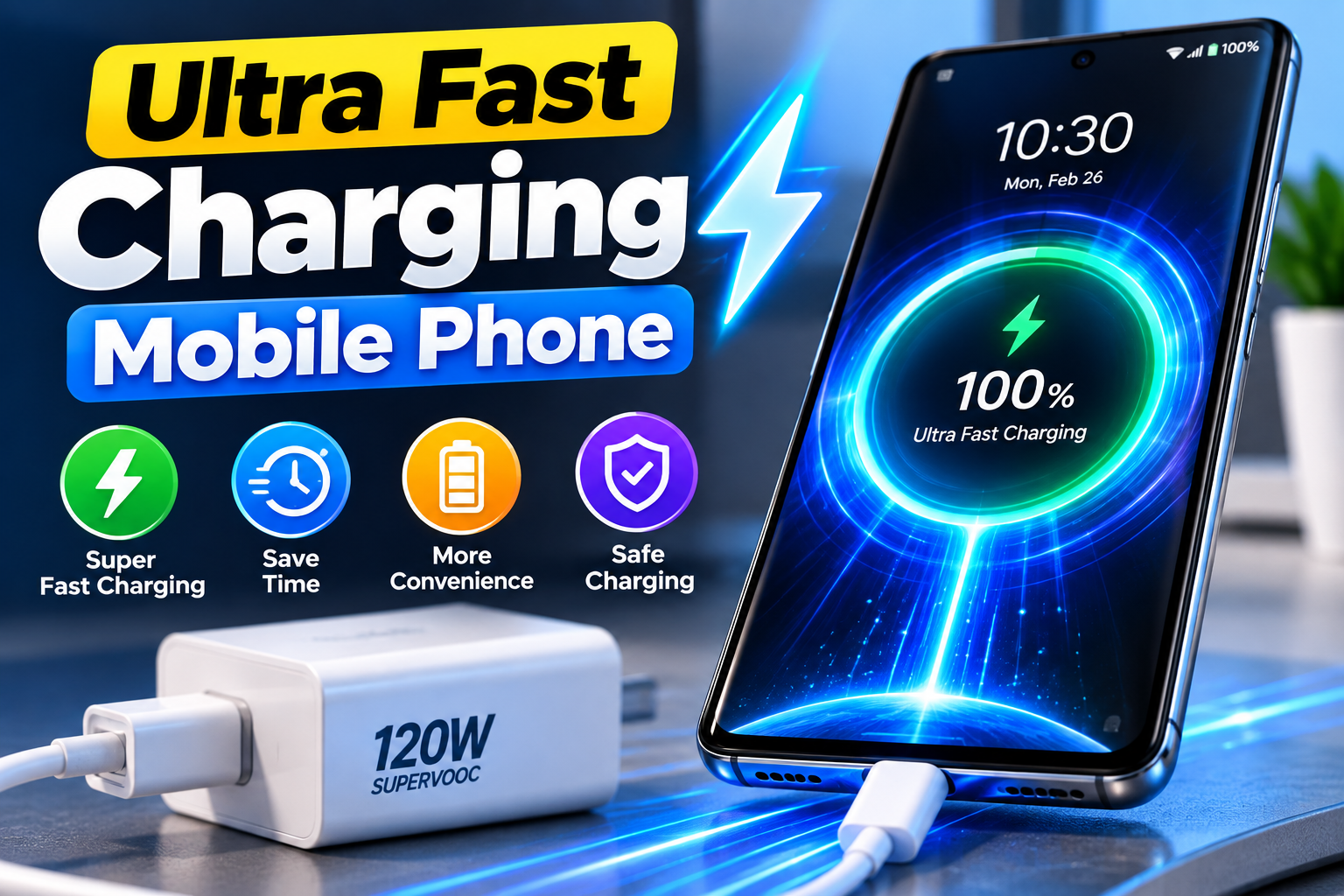
This is where the Ultra Fast Charging Mobile Phone comes in. Modern charging technologies can deliver considerably more power than traditional chargers, allowing smartphones to regain a large portion of their battery in a short period.
But how does ultra-fast charging actually work? Is it safe, and can it affect battery health? Let’s explore these questions in detail.
What Is an Ultra Fast Charging Mobile Phone?
An Ultra Fast Charging Mobile Phone is a smartphone that supports high-power charging technology. Instead of relying on the lower power levels used by older chargers, these devices can accept significantly higher charging power.
Depending on the model, modern smartphones may support charging speeds such as:
- 25W
- 45W
- 65W
- 80W
- 100W
- 120W or more
Higher charging power can reduce the amount of time needed to recharge the battery, although actual speeds vary between different phones and charging systems.
How Does Ultra-Fast Charging Work?
Ultra-fast charging isn’t simply about using a more powerful adapter. The smartphone, charger, cable, and battery must all be designed to work together.
The main elements include:
- High-power charging adapter
- Compatible USB cable
- Charging control hardware
- Battery management software
The phone constantly monitors charging conditions such as voltage, current, temperature, and battery percentage. The charging system can then adjust the power level to maintain efficiency and control heat.
Some smartphones also use multiple battery cells so that charging power can be distributed more effectively.
Major Benefits of Ultra-Fast Charging
A high-speed charging system can be particularly useful for people who use their phones heavily throughout the day.
1. Saves Charging Time
The biggest advantage is obvious: less waiting.
Depending on the device and charger, some smartphones can reach a significant percentage of battery capacity within 15–20 minutes.
2. Ideal for Busy Users
If your battery is low before leaving home, a short charging session can provide a useful power boost without requiring a long wait.
3. Helpful During Emergencies
Even a few minutes connected to a suitable charger can provide enough battery for calls, messages, navigation, or other essential activities.
4. Useful for Travelers
Fast charging can be particularly convenient when traveling because you spend less time connected to a wall outlet.
Does Ultra-Fast Charging Harm the Battery?
Battery degradation is unavoidable. Every rechargeable battery gradually loses some of its original capacity after repeated use.
However, modern Ultra Fast Charging Mobile Phone models use different technologies to control the charging process. These may include:
- Temperature sensors
- Current and voltage monitoring
- Adaptive charging
- Thermal management
- Software-based charging optimization
Heat is an important factor in battery aging. For this reason, the phone may automatically reduce charging power when temperatures become high or when the battery approaches full capacity.
For better battery longevity, avoid unnecessary exposure to extreme heat and follow the charging recommendations provided by the manufacturer.
Safety Tips for Ultra-Fast Charging
High-power charging should always be used with compatible accessories and under suitable conditions.
Here are some useful precautions:
- Use the manufacturer’s recommended charger whenever possible.
- Choose a reliable and compatible charging cable.
- Avoid damaged or extremely low-quality chargers.
- Don’t place a charging phone under a pillow or blanket.
- Keep the device away from excessive heat.
- Avoid demanding gaming sessions if the phone becomes unusually hot while charging.
- Install software and system updates when available.
Following these practices can help maintain safe charging performance.
Ultra-Fast Charging vs. Standard Fast Charging
The term fast charging covers a wide range of charging speeds. Not every fast-charging phone provides the same performance.
Some devices support approximately 18W or 25W, while more advanced models can reach 45W, 65W, 100W, 120W, or higher.
However, maximum wattage doesn’t mean the phone will continuously charge at that level.
Actual charging performance depends on several factors, including:
- Current battery percentage
- Device temperature
- Charger capacity
- Cable compatibility
- Battery condition
- Supported charging protocol
Charging often becomes slower as the battery approaches full capacity. This is part of the phone’s charging management system.
Which Smartphones Offer Ultra-Fast Charging?
Ultra-fast charging is available across several smartphone categories. Depending on the manufacturer, you may find it in:
- Flagship smartphones
- Premium mid-range phones
- Gaming devices
- Performance-focused Android phones
- Foldable smartphones
Charging specifications can differ substantially between models, so it’s important to check the official specifications rather than relying only on the advertised charging wattage.
Should You Buy an Ultra Fast Charging Phone?
Whether ultra-fast charging is useful for you depends on your daily smartphone habits.
People who frequently use their phones for gaming, business, video recording, navigation, social media, or content creation may appreciate the ability to quickly restore battery power.
For someone who mainly uses a phone for calls, messaging, and occasional browsing, a conventional fast-charging system may already provide enough performance.
When purchasing a phone, charging speed should therefore be considered alongside battery capacity, camera quality, processor performance, display, software support, and other specifications.
What Does the Future of Charging Look Like?
Smartphone charging technology continues to advance. Manufacturers and researchers are exploring ways to make batteries faster to charge while improving efficiency and longevity.
Some areas receiving attention include:
- Faster wireless charging
- AI-based charging optimization
- Advanced battery management
- Improved thermal control
- Solid-state battery technology
- More energy-efficient charging systems
These developments could make future smartphones even more convenient to recharge.
Conclusion
The Ultra Fast Charging Mobile Phone has changed the way people think about smartphone batteries. Instead of waiting for long periods, users can now restore a substantial amount of battery power in a relatively short time.
Modern devices combine powerful chargers, compatible cables, intelligent charging controllers, and battery protection technologies to manage high-speed charging.
For the best experience, always use suitable charging accessories and avoid excessive heat. With proper charging habits, ultra-fast charging can provide significant convenience without unnecessarily compromising battery performance.
Frequently Asked Questions
What is an Ultra Fast Charging Mobile Phone?
It is a smartphone capable of accepting relatively high charging power, allowing its battery to recharge considerably faster than conventional charging systems.
Is ultra-fast charging safe?
Generally, yes, when the phone and charging accessories are compatible and used according to the manufacturer’s recommendations.
Can fast charging affect battery health?
Battery capacity naturally decreases over time. Heat and charging conditions can influence the rate of battery aging, which is why modern phones use charging-management systems.
Can I use a normal charger with an ultra-fast charging phone?
In most cases, yes. However, a lower-power charger will charge the phone more slowly and may not provide the device’s maximum charging speed.
Is 45W considered ultra-fast charging?
45W is commonly described as ultra-fast charging, but there is no universal industry threshold. Different manufacturers use different terminology.
Does a 120W charger always charge at 120W?
No. The actual power depends on the phone’s supported charging speed, charger, cable, battery level, temperature, and charging protocol.